
Do liquid scintillation counters need a built-in calibration source?
1st September 2026
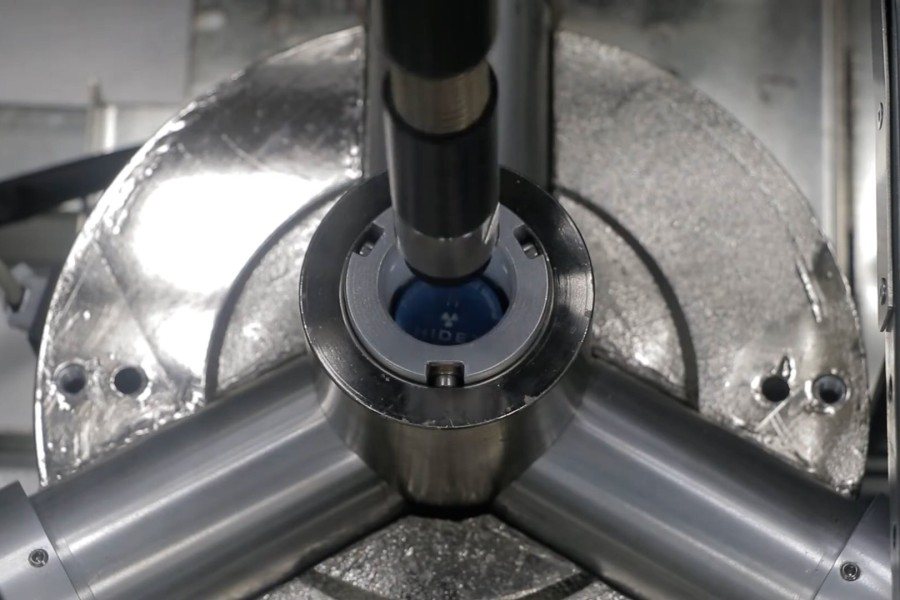
Hidex liquid scintillation counters use three photomultiplier detectors positioned at 120° to one another around the sample for improved detection efficiency.
Hidex counters use TDCR to enable absolute activity measurements without the need for a radioactive source for reference
Traditionally, many liquid scintillation counters have relied on internal radioactive calibration sources to provide a controlled reference for instrument performance. However, the Hidex 300 SL and 600 SLe counters use Triple-to-Double Coincidence Ratio (TDCR) to enable absolute activity measurement without the need for an internal source housed inside the instrument.
This removes several practical and radiation safety concerns associated with conventional counters, while providing an accurate method for liquid scintillation counting.
The challenges of internal radioactive calibration sources
Older counters typically use sources such as barium or caesium to characterise detector efficiency, monitor instrument stability and support quench correction. While the source is normally shielded and inaccessible during routine operation, its presence introduces additional considerations for the end user.
For example, access to the source during routine servicing and preventative maintenance presents the risk of exposure. If shielding is damaged or the integrity of a sealed source is compromised, there is also the potential for contamination, as well as contributing to elevated background readings and spoiling the counter’s measurements.
An internal source can also affect the practicalities of moving and disposing of an instrument. Depending on the source and applicable regulations, additional requirements may apply when transporting or relocating the counter between laboratories. At the end of its operational life, the radioactive source must also be appropriately managed, increasing disposal costs.
How do Hidex liquid scintillation counters work without an internal source?
TDCR is an absolute activity measurement technique that determines detection efficiency from the scintillation events detected by the instrument itself, rather than relying on a radioactive calibration source.
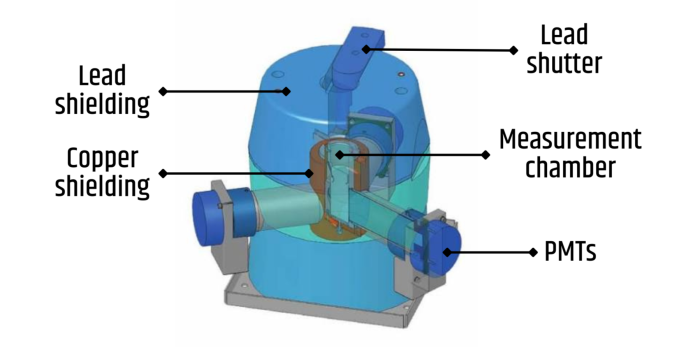
Both the Hidex 300 SL and 600 SLe use three photomultiplier detectors positioned at 120° to one another around the sample. This three-detector geometry provides improved detection efficiency compared with conventional two-detector coincidence systems. This analyses the relationship between triple and double coincidence events to determine the counting efficiency and, consequently, the activity of the sample.
Simplify quench correction with TDCR
One of the key advantages of TDCR is its performance in the presence of constant quenching in samples. Quenching reduces the amount of light produced by a radioactive decay event and will therefore reduce counting efficiency. It can result from the chemical composition of a sample or from colour within the sample, making accurate quench correction an important part of liquid scintillation counting.
TDCR is applicable across a broad range of sample conditions, including chemical and colour quenching, aqueous and organic samples, different scintillation cocktails and different radionuclides.
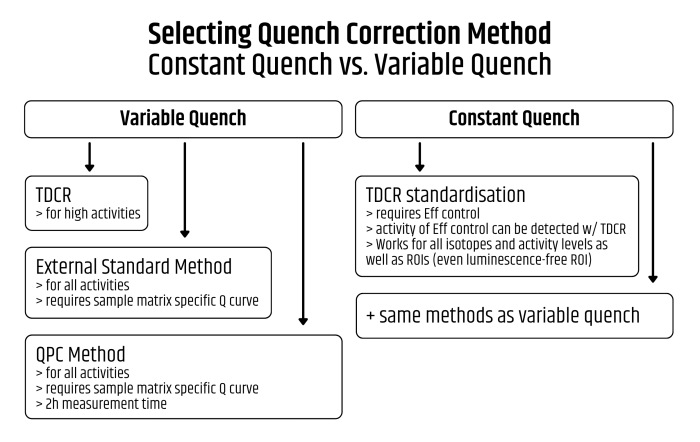
TDCR quench corrections can be performed for samples with constant quench or with variable quench for higher activity samples. This offers an alternative to the time-consuming process of preparing, maintaining and routinely counting a quench set.
Are you working with low-level environmental samples with variable quench?
If your laboratory is working with low-level environmental samples with variable amounts of quenching, an external 152Eu standard source may be included with the Hidex counter to provide the option of using the traditional external standard quench correction method. Many ISO 17025 accredited testing facilities appreciate the flexibility to use the TDCR method when appropriate, while still having the ability to properly analyse low-level LSC samples with variable degrees of quench, ensuring their continued accreditation.
Find out more
You can learn more about Hidex counters and TDCR by clicking the button below to speak to a product specialist directly.